🧩 The Transcendental Argument (TAG) Van Til · Bahnsen · Science requires God
This One Comes First. Because It Changes Everything Else.
This is not an argument from science. It is an argument that science itself only makes sense if God exists. That is a different level entirely — and almost nobody talks about it.
Developed by philosopher Cornelius Van Til and formalized by logician Greg Bahnsen, the Transcendental Argument asks a simple question: what are the preconditions for human reasoning to work at all? (Van Til, A Survey of Christian Epistemology, 1932; Bahnsen, Always Ready, Covenant Media Foundation, 1996).
The Argument:
→ The laws of logic are universal, abstract, and invariant. They apply everywhere, always, equally.
→ The uniformity of nature — the assumption that the future will behave like the past — is required for any scientific experiment to be repeatable or meaningful.
→ Objective moral standards are required to say that intellectual honesty, proper methodology, and truth-telling are obligatory for scientists.
→ None of these three things — logic, uniformity, moral obligation — can be justified by a purely material universe of atoms and forces.
Conclusion: Every time an atheist scientist runs an experiment, writes a paper, and appeals to logic to refute a theist, they are borrowing the intellectual furniture of a theistic worldview. They are standing on our floor to saw off our branch.
→ The laws of logic are universal, abstract, and invariant. They apply everywhere, always, equally.
→ The uniformity of nature — the assumption that the future will behave like the past — is required for any scientific experiment to be repeatable or meaningful.
→ Objective moral standards are required to say that intellectual honesty, proper methodology, and truth-telling are obligatory for scientists.
→ None of these three things — logic, uniformity, moral obligation — can be justified by a purely material universe of atoms and forces.
Conclusion: Every time an atheist scientist runs an experiment, writes a paper, and appeals to logic to refute a theist, they are borrowing the intellectual furniture of a theistic worldview. They are standing on our floor to saw off our branch.
Ask a materialist: Why does the law of non-contradiction apply in Australia the same way it applies in Norway? It is not made of matter. It is not located anywhere. It does not evolve. Under materialism, it has no grounding. Under theism, it reflects the rational, consistent mind of the Creator. The universe is intelligible because it was made by Intelligence.
"The very tools you use to argue against God — logic, evidence, consistency, the reliability of your own cognitive faculties — all of them presuppose exactly the kind of ordered, rational, morally-governed universe that theism predicts and materialism cannot explain."
This argument does not depend on any specific scientific finding. It cannot be overturned by new data. It operates at the level of epistemology — the study of how knowledge is possible at all. If you want to reject it, you have to explain where logic comes from in a universe of blind particles. Nobody has done that satisfactorily.
→
📜 Shroud of Turin 3D encoded · blood chemistry · STURP
No Pigments. No Dyes. No Explanation.
No pigments, dyes, or biochemicals. X-ray fluorescence, UV, and IR analysis by the Shroud of Turin Research Project (STURP, 1978–1981) — a team of 33 scientists from NASA, Los Alamos National Laboratory, and major universities — confirm the image is not painted. There is no binder. No pigment penetration. No foreign substance of any kind embedded in the fibers. (Heller & Adler, Canadian Society of Forensic Science Journal, 14:3, 1981).
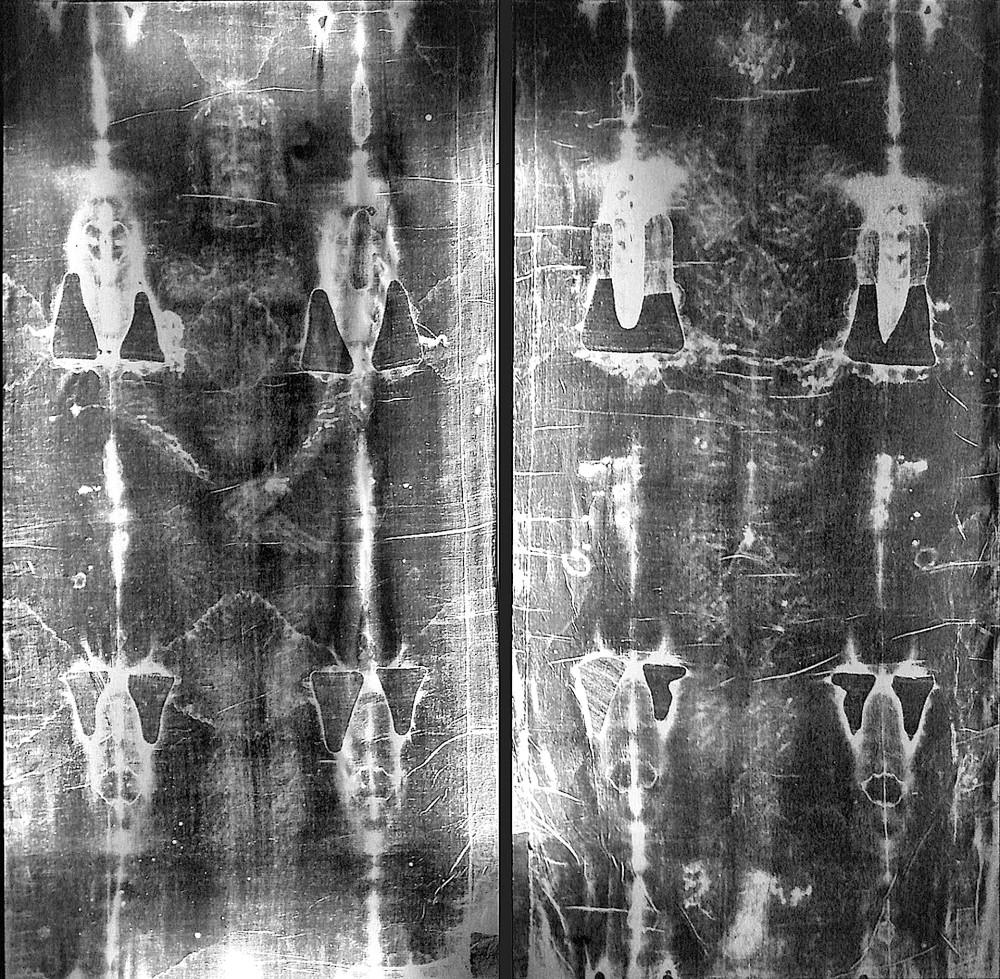
The Shroud of Turin — VP-8 Image Analyzer reveals 3D encoded data impossible to produce by medieval methods
Then NASA scientists John Jackson and Eric Jumper ran it through a VP-8 Image Analyzer in 1976. This device converts brightness gradients into 3D topographic relief. Every photograph ever made produces a flat, distorted output. The Shroud produced a perfect, undistorted three-dimensional relief of a human body. That cannot happen with a painting. That cannot happen with a photograph. That cannot happen with any contact method. The brightness on the cloth encodes cloth-to-body distance — a property with no natural explanation. (Jackson, Jumper & Ercoline, IEEE 1977 International Conference on Cybernetics and Society, pp. 559–575).
🔬 Blood evidence (STURP, 1981): Hemoglobin, serum albumin, and bilirubin positively identified. Blood transferred before the image formed — the image is absent beneath the bloodstains. Type AB blood. The wounds match Roman crucifixion protocol: scourge marks consistent with flagrum with dumbbell-shaped metal tips, crown of thorns, nail entry through wrists (not palms), and a post-mortem spear wound producing blood-serum separation visible as a red ring around the stain. Every wound maps precisely to first-century Roman execution methods.
"The Shroud of Turin is either the greatest work of art in human history — or it's authentic. There is no middle ground."
Why Every Forgery Theory Fails
Medieval painting? No pigment found. Acid etching? Leaves chemical residue — none found. Bas-relief rubbing? Produces distorted 3D data — the Shroud produces undistorted. Photography? Requires silver compounds — none found. The image resides in a superficial carbohydrate layer 200 nanometers thick — less than 0.2 microns — on the outermost surface of individual linen fibers, with no binder or pigment penetration below. No imaging technology in existence today can create a controlled image at that resolution and depth uniformly across a 14-foot cloth. (Fanti & Maggiolo, Journal of Optics A, 6:6, 2004). The 1988 radiocarbon dating result of 1260–1390 AD has been challenged by peer-reviewed rebuttal: Rogers (2005) in Thermochimica Acta demonstrated the tested samples were from a 16th-century repair patch with rewoven cotton fibers, chemically distinct from the main body of the cloth.
→
⛏️ Archaeological Proofs — Verifiable Artifacts 700+ confirmed · 0 contradictions
The Dirt Doesn't Lie
Over 700 specific cities, people, rulers, events, and geographic details mentioned in the Bible have been independently confirmed by archaeology. Zero have been definitively disproven. (Bryant Wood, Associates for Biblical Research; cross-referenced in May, Oxford Bible Atlas, 1984). These are not interpretations. These are physical objects in museums you can visit today.
700+Biblical locations confirmed by archaeology
0Confirmed archaeological contradictions to Scripture
925 BCKetef Hinnom Scrolls — oldest biblical text
9th c. BCTel Dan Stele — "House of David" extrabiblically confirmed
Ketef Hinnom Scrolls (Israel Museum, Jerusalem — IAA 1979-1283/1284)
In 1979, archaeologist Gabriel Barkay excavated tomb caves at Ketef Hinnom near Jerusalem and found two tiny silver amulets — rolled scrolls smaller than a cigarette. When unrolled under laboratory conditions, they contained the priestly blessing from Numbers 6:24–26 ("The Lord bless thee and keep thee..."). Carbon dating places them at 925–586 BC, making them the oldest known biblical text by approximately 400 years — predating the Dead Sea Scrolls. The text is identical to what is in the Bible today. (Barkay et al., Bulletin of the American Schools of Oriental Research, 334:41–71, 2004).
Tel Dan Stele (Israel Museum — IAA 1993-3162)
In 1993, archaeologist Avraham Biran discovered fragments of a basalt victory inscription at Tel Dan, dated to the 9th century BC, written by a Syrian king. The crucial phrase: "bytdwd" — House of David. This is the first extrabiblical reference to King David ever found. Secular scholars had argued David was mythological. The stele destroys that claim entirely. (Biran & Naveh, Israel Exploration Journal, 43:81–98, 1993).
Siloam Tunnel Inscription (Istanbul Archaeological Museums)
Found in 1880 inside Hezekiah's Tunnel beneath Jerusalem — a 6-line Hebrew text describing workers digging from opposite ends of a 533-meter tunnel hearing each other's pickaxes and meeting in the middle. 2 Kings 20:20 describes Hezekiah making a pool and conduit bringing water into the city. The inscription confirms the event, method, and engineering. The tunnel survives and can be walked today. (Millard, Tyndale Bulletin, 45:113–117, 1994).
The Pilate Stone (Israel Antiquities Authority, Caesarea Maritima)
For centuries, critics claimed Pontius Pilate was a fictional character. In 1961, a limestone block was found at Caesarea Maritima bearing the inscription: "Pontius Pilatus, Praefectus Iudaeae." Pontius Pilate. Prefect of Judaea. Exact title, exact region, exact time period. (Frova, Rendiconti dell'Istituto Lombardo, 95:419–434, 1961).
For more on how archaeology connects to fulfilled prophecy, see our Prophecy Evidence page.
→
🌌 Improbability of Life Barrow & Tipler · genome odds
The Numbers That Should End the Debate
John D. Barrow (cosmologist, University of Cambridge) & Frank J. Tipler (mathematical physicist, Tulane University) — The Anthropic Cosmological Principle (Oxford University Press, 1986). The universe's physical constants are finely tuned to an incomprehensible degree, allowing chemistry, stars, and life to exist at all.
10⁻¹¹·⁹ᴹlower bound probability for human genome
10⁻²³·⁸ᴹupper bound (4⁻³⁹·⁶ᴹ)
10⁻⁵⁰accepted mathematical impossibility threshold (Borel)
The odds they calculate for the human genome range from 4−19,800,000 to 4−39,600,000 — roughly 10−11.9 million to 10−23.8 million. That is not a metaphor. A number so vast that even if every grain of sand on Earth were a slot machine spinning every second for the age of the universe, you would not expect the required sequence to emerge even once.
"The fine-tuning and sequential improbability make the origin of life by chance alone an extreme statistical anomaly — straining credulity beyond the available time and mass of the cosmos."
→
⚡ The Cosmological Constant — 1 in 10¹²⁰ Lambda · Hoyle · Penrose · Dark energy
The Most Precisely Tuned Number in All of Physics
The cosmological constant (Λ) measures the energy density of empty space — what we call dark energy. It controls the expansion rate of the universe. And it is tuned with a precision that physicists find genuinely disturbing.
Quantum field theory predicts a value for Lambda based on known physics. The predicted value is 10120 times larger than what is observed. The observed value is almost exactly zero — but not quite. Nobel laureate Steven Weinberg called this "the worst failure of an order-of-magnitude estimate in the history of science." (Reviews of Modern Physics, 61:1, 1989).
If Lambda were larger by 1 part in 10¹²⁰
The universe would have expanded so fast after the Big Bang that matter could never clump together. No galaxies. No stars. No planets. No chemistry. No life. A diffuse featureless void.
If Lambda were smaller (or negative)
The universe would have collapsed back on itself within microseconds of the Big Bang. Total gravitational recollapse before any structure could form.
🔭 Roger Penrose's calculation (The Road to Reality, Knopf, 2004, Ch. 27):
The precision required to produce our universe from random initial conditions is 1 in 10^(10^123). This superscript is itself an exponent: ten to the power of ten to the power of 123. Penrose writes this number "is incomprehensible to ordinary human intuition." He is being polite.
The precision required to produce our universe from random initial conditions is 1 in 10^(10^123). This superscript is itself an exponent: ten to the power of ten to the power of 123. Penrose writes this number "is incomprehensible to ordinary human intuition." He is being polite.
"A common sense interpretation of the facts suggests that a superintellect has monkeyed with physics, as well as with chemistry and biology, and that there are no blind forces worth speaking about in nature. The numbers one calculates from the facts seem to me so overwhelming as to put this conclusion almost beyond question."
Hoyle's Carbon Resonance — When an Atheist Predicted God's Fingerprint
Fred Hoyle discovered that carbon-12 — the backbone of all organic life — has a nuclear resonance level at exactly 7.656 MeV. If that resonance were slightly different, the triple-alpha process in stars would not produce carbon in sufficient quantities. Hoyle predicted this resonance level must exist before it was measured, based purely on: "Life exists, therefore it must." When confirmed experimentally (Dunbar et al., Physical Review, 92:649–650, 1953), he concluded the universe looks like "a put-up job." (Annual Review of Astronomy and Astrophysics, 20:1–35, 1982). A committed atheist following his data to a conclusion he found uncomfortable. That is what intellectual honesty looks like.
→
📖 Prophecies & Probability Stoner · 1 in 10¹⁷ for 8 · 10¹⁵⁷ for 48
Not Vague Horoscopes. Specific. Verifiable. Centuries in Advance.
Peter Stoner, Science Speaks (Moody Press, 1963) — examined 8 major Messianic prophecies with a committee of 600 scientists from the American Scientific Affiliation. Result: 1 in 10¹⁷. Equivalent to covering Texas 2 feet deep in silver dollars, marking one, and having a blindfolded person pick it on the first try.
| Prophecy | Reference | Odds (1 in...) |
|---|---|---|
| Born in Bethlehem | Micah 5:2, ~700 BC | 280,000 |
| Preceded by a messenger | Malachi 3:1, ~430 BC | 1,000 |
| Betrayed by a friend | Psalm 41:9, ~1000 BC | 10 |
| 30 pieces of silver | Zechariah 11:12, ~520 BC | 100,000 |
| Money thrown in temple / potter's field | Zechariah 11:13 | 100,000 |
| Silent before accusers | Isaiah 53:7, ~700 BC | 1,000 |
| Hands and feet pierced | Psalm 22:16, ~1000 BC | 10,000 |
| Crucified among criminals | Isaiah 53:12 | 1,000 |
48 prophecies → 1 in 10¹⁵⁷. The mathematical impossibility threshold is 1 in 10⁵⁰. This is 10107 orders of magnitude beyond that line.
📍 Ezekiel 26 (~590 BC): Predicted Nebuchadnezzar would destroy the mainland city of Tyre, that the ruins would be thrown into the sea and the site scraped bare like a rock. Alexander the Great (332 BC) scraped the ruins into the sea to build a causeway to the island fortress — fulfilling every detail. The mainland site remains bare to this day.
📜 Isaiah 45:1 (~700 BC): Names Cyrus by name — says he will open gates and order the Jerusalem temple rebuilt — 150+ years before Cyrus was born. The Ketef Hinnom Scrolls (925–586 BC) prove Isaiah was circulating long before Cyrus existed, destroying the late-authorship secular rebuttal.
📜 Isaiah 45:1 (~700 BC): Names Cyrus by name — says he will open gates and order the Jerusalem temple rebuilt — 150+ years before Cyrus was born. The Ketef Hinnom Scrolls (925–586 BC) prove Isaiah was circulating long before Cyrus existed, destroying the late-authorship secular rebuttal.
→
🔬 Anachronistic Scientific Precision Texts thousands of years ahead of their time
Knowledge Nobody Should Have Had
Day 8Vitamin K & prothrombin peak — Leviticus 12:3
Job 26:7Earth suspended in space — 3,000 years early
♀ AntsFeminine pronoun for workers — Proverbs 6:6
Psalm 8:8Ocean current paths — confirmed 1855 AD
- Circumcision day 8 (Leviticus 12:3, ~1400 BC): Prothrombin and Vitamin K levels peak on day 8. Before day 8, bleeding risk is elevated. After day 8, levels decline. No ancient biochemistry understood coagulation cascades — yet the command specifies day 8 exactly. (McMillen & Stern, None of These Diseases, Revell, 2000).
- Job 26:7 (~2000 BC): "He hangs the earth on nothing." Every surrounding cosmology — Babylonian, Egyptian, Greek, Hindu — described the earth resting on pillars or cosmic structures. Only the Hebrew text says: nothing. This predates Copernicus by ~3,500 years.
- Ant gender accuracy (Proverbs 6:6, ~950 BC): The Hebrew uses a feminine singular verb for the working ant. Worker ants are sterile females. Aristotle, writing 600 years later, still thought worker ants were male. Probability of guessing correctly: 1 in 2. One more data point in a consistent pattern.
- Ocean currents (Psalm 8:8, ~1000 BC): "...whatever passes through the paths of the seas." Matthew Fontaine Maury, father of oceanography, discovered global current systems after his daughter read this verse to him during an illness. His Physical Geography of the Sea (1855) mapped them. He said he would find those paths.
- Quarantine protocols (Leviticus 13–14, ~1400 BC): Detailed isolation procedures for infectious disease including 7-day quarantine periods. Germ theory was not established until Pasteur and Lister in the 1860s. Medieval Europe had no such protocols — a significant factor in the Black Death's catastrophic spread. The Hebrew camps did.
→
🦕 The Cambrian Explosion Darwin's admitted objection · Meyer · 5M year window
Every Animal Blueprint. All At Once. With No Ancestors.
This is the one Darwin himself could not explain. In a geological blink — roughly 5–10 million years out of 3.8 billion years of life on Earth — virtually every major animal body plan appears in the fossil record simultaneously, with no identifiable fossil precursors in earlier strata. The Cambrian Explosion begins approximately 541 million years ago. (Erwin et al., Science, 331:721–725, 2011).
Think about what that means. Before the Cambrian: almost exclusively single-celled organisms and simple multicellular life. Then in a geologically instantaneous moment: eyes, brains, hearts, limbs, shells, nervous systems, digestive tracts, bilateral symmetry, radial symmetry — dozens of fundamentally different body plans, all appearing at once, many with no simpler precursor forms anywhere in the record below them.
"The abrupt manner in which whole groups of species suddenly appear in certain formations has been urged by several palaeontologists... as a fatal objection to the belief in the transmutation of species. If numerous species, belonging to the same genera or families, have really started into life all at once, the fact would be fatal to the theory of descent with slow modification through natural selection."
Why "We Just Haven't Found the Fossils" Doesn't Work
This was Darwin's own proposed escape: the fossil record is incomplete. We will find the precursors. That was 165 years ago. We have now excavated and catalogued the fossil record on every continent with extraordinary detail. The Precambrian strata are not empty — they contain abundant microbial mats, stromatolites, and Ediacaran organisms. What they do not contain is the ancestral forms that Darwinian gradualism requires. The absence is not a gap in our search. It is a pattern in the data. (Meyer, Darwin's Doubt, HarperOne, 2013).
🧬 The Information Problem:
Each new Cambrian body plan requires hundreds to thousands of new, coordinated protein-coding genes — genes that must work together from the start to produce viable organisms. A new animal body plan is not the result of one or two mutations. It requires the simultaneous, coordinated appearance of new genetic regulatory networks, new developmental programs, new structural proteins, and new biochemical pathways.
Stephen Meyer (Ph.D., History and Philosophy of Science, Cambridge) demonstrates in Darwin's Doubt (2013) that the probabilistic resources of the entire history of life on Earth are not sufficient to search the combinatorial space required to produce even one new body plan by random mutation and selection — let alone the 20+ that appear simultaneously in the Cambrian. The math is the same category as Axe's protein fold calculation: physically impossible by chance.
Each new Cambrian body plan requires hundreds to thousands of new, coordinated protein-coding genes — genes that must work together from the start to produce viable organisms. A new animal body plan is not the result of one or two mutations. It requires the simultaneous, coordinated appearance of new genetic regulatory networks, new developmental programs, new structural proteins, and new biochemical pathways.
Stephen Meyer (Ph.D., History and Philosophy of Science, Cambridge) demonstrates in Darwin's Doubt (2013) that the probabilistic resources of the entire history of life on Earth are not sufficient to search the combinatorial space required to produce even one new body plan by random mutation and selection — let alone the 20+ that appear simultaneously in the Cambrian. The math is the same category as Axe's protein fold calculation: physically impossible by chance.
The Cambrian Explosion is not a mystery at the fringes of evolutionary theory. It is a frontal challenge to the core mechanism. 165 years after Darwin flagged it himself, it remains unsolved. (Gould, Wonderful Life, Norton, 1989 — even the committed Darwinist Stephen Jay Gould acknowledged the Cambrian as deeply problematic).
→
🧬 DNA as Information — Not Chemistry Crick · Shannon · Dawkins' own words
The Code That Cannot Write Itself
Here is a fact that changes the entire origin of life debate — and almost nobody frames it this way. DNA is not primarily a chemical phenomenon. It is an information phenomenon. The sequence of base pairs in DNA functions exactly like digital code — and information theory has an iron law about where information comes from.
Francis Crick, co-discoverer of DNA's structure and a lifelong atheist, formulated the Sequence Hypothesis (1958): the specific sequence of nucleotides in DNA carries information that is entirely independent of the chemical properties of the nucleotides themselves. The chemical bonds are just the medium. The sequence is the message. (Crick, On Protein Synthesis, Symposia of the Society for Experimental Biology, 12:138–163, 1958).
"The machine code of the genes is uncannily computer-like. Apart from differences in jargon, the pages of a molecular biology journal might be interchanged with those of a computer engineering journal."
💻 Shannon's Information Theory (1948) has one empirically confirmed source of specified complex information: intelligence.
Claude Shannon (A Mathematical Theory of Communication, Bell System Technical Journal, 1948) established that information is measured by the reduction of uncertainty in a sequence of symbols. "Specified complexity" — a long sequence that is both highly improbable AND conforms to an independent functional specification — has been observed to arise from exactly one source in all of human experience: a mind.
DNA has 3.2 billion base pairs in the human genome. Each position encodes functional information. The sequence is not random — it is specified. It is not simple — it is complex. Shannon's framework gives us one known explanation. Intelligence.
Claude Shannon (A Mathematical Theory of Communication, Bell System Technical Journal, 1948) established that information is measured by the reduction of uncertainty in a sequence of symbols. "Specified complexity" — a long sequence that is both highly improbable AND conforms to an independent functional specification — has been observed to arise from exactly one source in all of human experience: a mind.
DNA has 3.2 billion base pairs in the human genome. Each position encodes functional information. The sequence is not random — it is specified. It is not simple — it is complex. Shannon's framework gives us one known explanation. Intelligence.
The Software Analogy Is Not a Metaphor
When Bill Gates says "DNA is like a computer program but far, far more advanced than any software ever created" (The Road Ahead, Viking, 1995, p. 228), he is not speaking poetically. He is speaking literally. DNA has: a four-letter alphabet (A, T, C, G), a reading frame, start and stop codons, error-correction mechanisms, redundancy encoding, overlapping reading frames, epigenetic regulation layers, and context-dependent meaning. Software engineers spend careers building systems that approximate a fraction of this complexity.
The question is not "can chemistry produce nucleotides?" Chemists can do that in a lab. The question is: what causes those nucleotides to arrange themselves into a specific, functional, information-bearing sequence? Chemistry explains the letters. It does not explain the message. Nobody — in 70 years of origin of life research — has demonstrated a chemical process that generates specified genetic information without intelligence directing the process. (Tour, Inference, 2016; Meyer, Signature in the Cell, HarperOne, 2009).
→
🧪 The Origin of Life Problem — In Plain English James Tour · Douglas Axe · 1 in 10⁷⁷
Let's Explain This So Simply That Nobody Can Dismiss It
Dr. James Tour (Rice University) is one of the ten most-cited chemists in the world according to Thomson Reuters. He builds molecules for a living. He knows what chemistry can and cannot do. And he says this bluntly: nobody in the world knows how life could have started from non-life without a chemist guiding the process. Not because we haven't thought hard enough. Because the chemistry doesn't work without guidance. (Tour, "Animadversions of a Synthetic Chemist," Inference: International Review of Science, 2:2, 2016).
Here is the simplest possible way to understand the problem. Imagine you have a kitchen. It has all the ingredients for a cake — flour, eggs, butter, sugar. Leave them in the room for a billion years. You do not get a cake. You get rot. You get chemical breakdown. You get an unusable mess. The specific combination, in the specific order, at the specific temperature and time is what makes a cake — and that requires a baker.
Life is incomprehensibly more complex than a cake. And the "kitchen" of prebiotic Earth had none of the controlled conditions required. Here is what Tour's research actually shows, step by step:
- Problem 1 — Getting the ingredients: Making nucleotides (the letters of DNA) in a lab requires a chemist selecting pure reagents, controlling temperature, removing byproducts, and running reactions in sequence. In prebiotic Earth, you have a soup of thousands of chemicals all reacting with each other simultaneously. The right chemicals don't assemble — they get destroyed by the wrong reactions. Tour calls it "the contamination problem." No one has solved it.
- Problem 2 — Homochirality: Life uses only left-handed amino acids and right-handed sugars — like using only left-handed gloves. Random chemistry produces a 50/50 mix. One wrong-handed molecule in a protein chain destroys its function. There is no known abiotic mechanism that selectively produces or preserves one chirality. (Meierhenrich, Amino Acids and the Asymmetry of Life, Springer, 2008).
- Problem 3 — The RNA World dead end: The leading origin of life hypothesis says RNA came first and catalyzed its own replication. Problem: RNA degrades rapidly in water. RNA cannot self-replicate without protein enzymes. Protein enzymes cannot be made without RNA coding for them. This is a chicken-and-egg loop with no entry point. (Bernhardt, Biology Direct, 7:23, 2012).
- Problem 4 — Douglas Axe's protein fold number: Dr. Douglas Axe (Cambridge, Journal of Molecular Biology, 341:1295–1315, 2004) measured how often random amino acid sequences fold into a functional protein: 1 in 1077. The entire observable universe has ~1080 atoms. Total seconds since the Big Bang: ~4.3 × 10¹⁷. Even if every atom were a protein-assembly machine running since the Big Bang, you get 1097 attempts. A minimal viable cell needs 250–500 coordinated functional proteins simultaneously. Combined odds: 1 in 1038,500. The impossibility threshold is 1 in 1050. We are 38,450 orders of magnitude past impossible.
- Problem 5 — No demonstrated pathway, period: After 70 years and hundreds of millions in research funding, not one group has produced a self-replicating, information-bearing system without an intelligent chemist directing every step. The field openly acknowledges origin of life is unsolved. "One of the most profound unsolved problems in science." (Sutherland, Nature Chemistry, 8:1027–1029, 2016).
"No one has ever produced a self-replicating, information-bearing system from basic chemicals without an intelligent chemist in the lab. The coordination problem is overwhelming: multiple components must emerge simultaneously in the right configuration, concentration, and chirality."
→
🕊️ The Lourdes Medical Bureau — 72 Verified Inexplicable Cures IMCOSIL · Organic disease · Instantaneous · Permanent
The Most Rigorous Miracle Verification Process in History
Lourdes is not faith healing. It is not placebo. It is not psychology. The Bureau Médical de Lourdes and the International Medical Committee of Lourdes (IMCOSIL) apply a verification process that most clinical trials would envy. To be recognized as officially miraculous, a cure must satisfy all of the following:
- The disease must be serious, organic, and objectively diagnosed with pre-cure documentation (imaging, biopsies, lab results).
- The cure must be instantaneous or near-instantaneous — without convalescence or gradual recovery.
- The cure must be complete — no residual symptoms, no partial improvement.
- The cure must be permanent — documented for a minimum of several years post-event with follow-up examinations.
- The cure must be scientifically inexplicable — no known medical mechanism can account for it.
- No medical treatment was administered that could explain the recovery.
As of 2023, 72 cures have been officially declared miraculous by this process. Thousands more have been verified as medically inexplicable but not formally submitted through the full canonical process. The Medical Bureau's files have been reviewed by hundreds of physicians including committed atheists and agnostics.
Case Study — Delizia Cirolli (IMCOSIL Dossier No. 62, 1976)
Delizia Cirolli was a 12-year-old Sicilian girl diagnosed with Ewing's sarcoma of the right knee in 1975 — an aggressive primary bone cancer. X-rays documented the tumor. Her prognosis was terminal. Her family took her to Lourdes in December 1976. On the return journey, the swelling was gone. She could walk normally. Follow-up X-rays showed no tumor, no cancer cells, no evidence of any disease. IMCOSIL examined her over the following years and in 1989 declared her healing scientifically inexplicable. She was alive and healthy decades later. (IMCOSIL Official Dossier No. 62; Theillier, Des guérisons inexpliquées à Lourdes, Éditions de l'Emmanuel, 2013).
"I am not a believer. I came to Lourdes as a skeptic and a physician. What I have seen in these files I cannot explain by any mechanism available to modern medicine. The instantaneous resolution of organic pathology in multiple cases, confirmed by pre- and post-imaging, is not consistent with spontaneous remission in any pattern I recognize."
Alexis Carrel — Nobel Prize in Physiology or Medicine (1912) — visited Lourdes as an agnostic and witnessed a cure firsthand. He spent years trying to explain it away. He ultimately published The Voyage to Lourdes documenting what he saw and concluding it was inexplicable. For the full catalogue of documented healing evidence including modern prayer studies, visit our Healing Evidence page.
→
💡 Near-Death Experience Research van Lommel · The Lancet · AWARE study · Sam Parnia
This Is Not Anecdote. This Is Peer-Reviewed Cardiology.
The standard dismissal of near-death experiences is that they are hallucinations produced by a dying brain. That dismissal has a fatal problem: the most evidentially significant NDE cases occur when the brain is not producing anything — when EEG is flat, when blood flow has stopped, when by every measurable indicator brain function has ceased entirely. And patients are still reporting accurate, verifiable perceptions of their physical environment.
The Dutch Prospective NDE Study (van Lommel et al.)
Pim van Lommel and colleagues conducted a prospective study of 344 consecutive cardiac arrest patients who were successfully resuscitated across ten Dutch hospitals. Of these, 62 patients (18%) reported some form of NDE. The study was published in The Lancet — one of the oldest and most prestigious peer-reviewed medical journals in the world — in 2001 (358:2039–2045). Key findings: patients reported NDEs during periods of verified clinical death with flat EEG. The content of reports — verified out-of-body perceptions, accurate descriptions of resuscitation procedures, identification of staff and equipment — could not be explained by medication, fear, or lack of oxygen.
The AWARE Study (Parnia et al., Southampton)
Dr. Sam Parnia (University of Southampton, later NYU) led the AWARE (AWAreness during REsuscitation) study — the largest prospective study of its kind. 2,060 cardiac arrest patients were tracked across 15 hospitals. Researchers placed targets visible only from above the resuscitation table on high shelves — to test claims of out-of-body perception. One verified case of accurate out-of-body perception was documented during confirmed cardiac arrest with no measurable brain activity. Published in Resuscitation, 85:1799–1805, 2014.
🔬 Pam Reynolds (1991) — The Gold Standard Case:
Reynolds underwent a surgical procedure called hypothermic cardiac arrest — body temperature reduced to 60°F, heartbeat stopped, breathing stopped, EEG flat (zero brain activity), blood drained from her head. She was clinically dead by every measure. During this period she subsequently reported: the specific bone saw used to open her skull (an unusual model she had not previously seen, confirmed by surgical staff), the exact conversation among the surgical team, the music playing in the operating room, and details of her own open skull. Neurosurgeon Dr. Robert Spetzler, who performed the procedure, stated: "I don't have a good explanation for it." (Sabom, Light and Death, Zondervan, 1998, pp. 37–52).
A flat EEG means no brain activity. Hallucinations require brain activity. This is not complicated.
Reynolds underwent a surgical procedure called hypothermic cardiac arrest — body temperature reduced to 60°F, heartbeat stopped, breathing stopped, EEG flat (zero brain activity), blood drained from her head. She was clinically dead by every measure. During this period she subsequently reported: the specific bone saw used to open her skull (an unusual model she had not previously seen, confirmed by surgical staff), the exact conversation among the surgical team, the music playing in the operating room, and details of her own open skull. Neurosurgeon Dr. Robert Spetzler, who performed the procedure, stated: "I don't have a good explanation for it." (Sabom, Light and Death, Zondervan, 1998, pp. 37–52).
A flat EEG means no brain activity. Hallucinations require brain activity. This is not complicated.
"How can a clear consciousness outside one's body be experienced at the moment that the brain no longer functions during a period of clinical death? Our most important finding was that NDE is an authentic experience which cannot be simply reduced to imagination, fear of death, hallucination, psychosis, the use of drugs, or oxygen deficiency."
→
🧠 Consciousness, The Soul & Quantum Reality Hard problem · Egnor · Von Neumann–Wigner
The Hard Problem Nobody Can Solve
David Chalmers (Australian National University) coined the "hard problem of consciousness" in 1995: why and how do physical brain processes give rise to subjective experience — the felt quality of seeing red, hearing music, feeling pain? Materialism describes third-person behavior but fails to explain first-person awareness, abstract thought, and moral agency. This is a fundamental failure of the materialist framework. (Chalmers, The Conscious Mind, Oxford University Press, 1996).
⚡ Neurosurgeon Dr. Michael Egnor (Stony Brook University) — six reasons reason & free will are non-physical:
- No "math seizures": Over two centuries and millions of documented seizures, not one has been observed to cause logical reasoning deficit. Seizures affect memory, emotion, motor control — never abstract reasoning or mathematical ability.
- Brain stimulation cannot trigger reason: 400,000+ neurosurgical procedures involving direct brain stimulation have triggered movements, memories, emotions — but never a logical thought. No one has ever been stimulated into thinking "1+1=2."
- Hemispherectomy: Patients who have undergone removal of an entire cerebral hemisphere retain intact cognitive identity, personality, and reasoning ability. The brain does not contain the mind in a one-to-one mapping.
- Conjoined twins with shared thalamus (Tatiana & Krista Hogan): They share thalamic tissue — a deep brain structure. They report seeing through each other's eyes and controlling each other's limbs. Yet they maintain entirely separate conscious identities and separate free will. Same brain tissue. Different persons. Materialism cannot account for this.
- Near-death experiences: Pam Reynolds — brain dead (no EEG, no blood flow) reported surgical instruments and conversations verified by the surgical team. Dr. Spetzler: "I cannot explain it."
- The piano argument: The brain doesn't think — you think, using your brain. A piano doesn't play music; the pianist does. Destroying the piano destroys the music. But that doesn't prove the pianist is the piano.
The Von Neumann–Wigner Interpretation — Consciousness Is Logically Prior to Matter
Quantum mechanics presents a problem that goes further than neuroscience. The Copenhagen interpretation holds that a quantum system exists in superposition — all possible states simultaneously — until it is observed. The act of measurement collapses the wave function to a definite state. Mathematician John von Neumann demonstrated in Mathematical Foundations of Quantum Mechanics (1932) that the chain of physical causation regresses infinitely unless terminated by a non-physical observer. Nobel laureate Eugene Wigner extended this explicitly: consciousness must be outside the physical system. (Wigner, Symmetries and Reflections, Indiana University Press, 1967).
"It was not possible to formulate the laws of quantum mechanics in a fully consistent way without reference to consciousness."
The implication: if quantum mechanics requires a non-physical observer to produce definite physical reality, then consciousness is not emergent from matter. It is logically prior to matter. This is not fringe philosophy. It is a mainstream interpretation of quantum mechanics held by von Neumann, Wigner, and championed today by Henry Stapp (Lawrence Berkeley National Laboratory, Mind, Matter and Quantum Mechanics, Springer, 2011).
→
✝️ The Resurrection — Argued Purely Historically Habermas · Minimal facts · 500 witnesses
Five Facts. Accepted by Secular Historians. No Theological Premise Required.
This is not a theological argument. This is a historical argument. Dr. Gary Habermas (Liberty University, The Historical Jesus: Ancient Evidence for the Life of Christ, College Press, 1996) developed the Minimal Facts Argument: a set of historical facts about Jesus of Nazareth accepted by the overwhelming majority of critical scholars — including atheists, agnostics, and skeptics — based purely on standard historiographical methods, no faith required.
The Five Minimal Facts (accepted by 95%+ of critical historians):
1. Death by crucifixion: Confirmed by Tacitus (Annals, 15:44), Josephus (Antiquities, 18.3.3), and the unanimous testimony of all four Gospels and Paul's letters. Crucifixion was designed to be unsurvivable — Romans were experts at it.
2. Empty tomb: Enemies of Christianity in Jerusalem were claiming the disciples stole the body within weeks of the death. Nobody pointed to a body. The tomb was verifiably empty. Jewish authorities' own counter-narrative (Matthew 28:11–15) presupposes the empty tomb.
3. Post-mortem appearances: Paul writes (1 Corinthians 15:3–8, dated ~54 AD — within 25 years of the crucifixion) that Jesus appeared to Peter, to the Twelve, to 500 people at once, to James, and to Paul himself. Paul explicitly notes that most of the 500 were still alive when he wrote — an open invitation to verify.
4. Disciples' transformation to martyrdom: Frightened men who fled at the arrest go on to die for their testimony that Jesus rose. People die for things they believe to be true. People do not die for things they fabricated. The willingness to die — not in battle but by slow execution — is not the behavior of deliberate liars.
5. Paul's conversion: Paul was a Pharisee who actively persecuted Christians, overseeing the execution of Stephen. He converts suddenly, suffers imprisonment and execution, and never recants. His explanation: he personally encountered the risen Jesus on the road to Damascus. He had every worldly reason to remain a Pharisee. He had nothing material to gain.
1. Death by crucifixion: Confirmed by Tacitus (Annals, 15:44), Josephus (Antiquities, 18.3.3), and the unanimous testimony of all four Gospels and Paul's letters. Crucifixion was designed to be unsurvivable — Romans were experts at it.
2. Empty tomb: Enemies of Christianity in Jerusalem were claiming the disciples stole the body within weeks of the death. Nobody pointed to a body. The tomb was verifiably empty. Jewish authorities' own counter-narrative (Matthew 28:11–15) presupposes the empty tomb.
3. Post-mortem appearances: Paul writes (1 Corinthians 15:3–8, dated ~54 AD — within 25 years of the crucifixion) that Jesus appeared to Peter, to the Twelve, to 500 people at once, to James, and to Paul himself. Paul explicitly notes that most of the 500 were still alive when he wrote — an open invitation to verify.
4. Disciples' transformation to martyrdom: Frightened men who fled at the arrest go on to die for their testimony that Jesus rose. People die for things they believe to be true. People do not die for things they fabricated. The willingness to die — not in battle but by slow execution — is not the behavior of deliberate liars.
5. Paul's conversion: Paul was a Pharisee who actively persecuted Christians, overseeing the execution of Stephen. He converts suddenly, suffers imprisonment and execution, and never recants. His explanation: he personally encountered the risen Jesus on the road to Damascus. He had every worldly reason to remain a Pharisee. He had nothing material to gain.
"The resurrection of Jesus is the best-attested miracle claim in history — not because the evidence is perfect, but because the convergence of independent evidence streams and the failure of all naturalistic counter-explanations leaves the historian with only one hypothesis that adequately explains the data."
Why the "Hallucination" Theory Fails
The hallucination hypothesis requires mass simultaneous hallucination of 500 people — including Paul, a hostile witness with no psychological predisposition to such an experience, who saw Jesus after the initial appearances had ceased. Hallucinations are private, individual neurological events. There is no documented case in clinical literature of group hallucinations of a shared, detailed, physically interactive figure. The hypothesis is not cautious skepticism. It requires a miracle of its own. (Habermas & Licona, The Case for the Resurrection of Jesus, Kregel, 2004).
→
⚛️ Cosmological, Ontological & Moral Arguments Kalam · Plantinga · Moral · Wigner
Three Philosophical Arguments. Each Independently Valid.
★ Kalam Cosmological Argument (Al-Ghazali, 11th c.; Craig, The Kalam Cosmological Argument, Macmillan, 1979)
P1: Whatever begins to exist has a cause.
P2: The universe began to exist (Big Bang, 1965 CMB confirmation; Borde-Guth-Vilenkin theorem 2003 — all inflationary models require an absolute beginning).
C: Therefore the universe has a cause.
Properties of the cause: spaceless, timeless, immaterial, enormously powerful, and personal — because an impersonal cause cannot choose to initiate a temporal effect from a timeless state. This is a precise description of the God of classical theism.
P1: Whatever begins to exist has a cause.
P2: The universe began to exist (Big Bang, 1965 CMB confirmation; Borde-Guth-Vilenkin theorem 2003 — all inflationary models require an absolute beginning).
C: Therefore the universe has a cause.
Properties of the cause: spaceless, timeless, immaterial, enormously powerful, and personal — because an impersonal cause cannot choose to initiate a temporal effect from a timeless state. This is a precise description of the God of classical theism.
★ Plantinga's Modal Ontological Argument (Alvin Plantinga, The Nature of Necessity, Oxford, 1974)
P1: It is possible that a maximally great being exists.
P2: If it is possible that a maximally great being exists, then a maximally great being exists in some possible world.
P3: If a maximally great being exists in some possible world, it exists in all possible worlds (by definition of maximal greatness).
C: A maximally great being exists in the actual world. God exists.
The argument is formally valid — philosophers cannot find a logical flaw in its structure. The only dispute is over Premise 1. But to reject it, you must claim God is not merely unlikely — you must claim God is impossible. That is a far stronger claim, and none of the standard objections establish impossibility.
P1: It is possible that a maximally great being exists.
P2: If it is possible that a maximally great being exists, then a maximally great being exists in some possible world.
P3: If a maximally great being exists in some possible world, it exists in all possible worlds (by definition of maximal greatness).
C: A maximally great being exists in the actual world. God exists.
The argument is formally valid — philosophers cannot find a logical flaw in its structure. The only dispute is over Premise 1. But to reject it, you must claim God is not merely unlikely — you must claim God is impossible. That is a far stronger claim, and none of the standard objections establish impossibility.
★ Moral Argument (Lewis, Mere Christianity, 1952; Craig, Reasonable Faith, Crossway, 2008)
P1: If God does not exist, objective moral values do not exist — only socio-biological conventions shaped by evolutionary pressure.
P2: Objective moral values do exist: torturing infants for entertainment is not merely culturally disfavored — it is objectively wrong in all possible worlds.
C: Therefore, God exists.
The atheist response is typically: "Evolution explains moral intuitions." This concedes the point. Evolution explains why we feel moral impulses — not why any of them are actually binding. If morality is evolved behavior, the Holocaust was not evil — it was unfashionable.
P1: If God does not exist, objective moral values do not exist — only socio-biological conventions shaped by evolutionary pressure.
P2: Objective moral values do exist: torturing infants for entertainment is not merely culturally disfavored — it is objectively wrong in all possible worlds.
C: Therefore, God exists.
The atheist response is typically: "Evolution explains moral intuitions." This concedes the point. Evolution explains why we feel moral impulses — not why any of them are actually binding. If morality is evolved behavior, the Holocaust was not evil — it was unfashionable.
"The unreasonable effectiveness of mathematics in the natural sciences is something bordering on the mysterious... The miracle of the appropriateness of the language of mathematics for the formulation of the laws of physics is a wonderful gift which we neither understand nor deserve."
→
🔥 A First-Person Account — Hell's Deepest Dominion B.W. Melwin · Clinical death · Physical verification
He Died. He Saw Christ. He Was Shown Hell. He Came Back With Proof.
Most NDE accounts describe light, peace, and beauty. This one is different. B.W. Melwin's testimony — documented in his book Hell's Deepest Dominion — describes a clinical death experience in which he encountered Christ, was granted a vision of Hell, and returned with a physical detail he could not have fabricated.
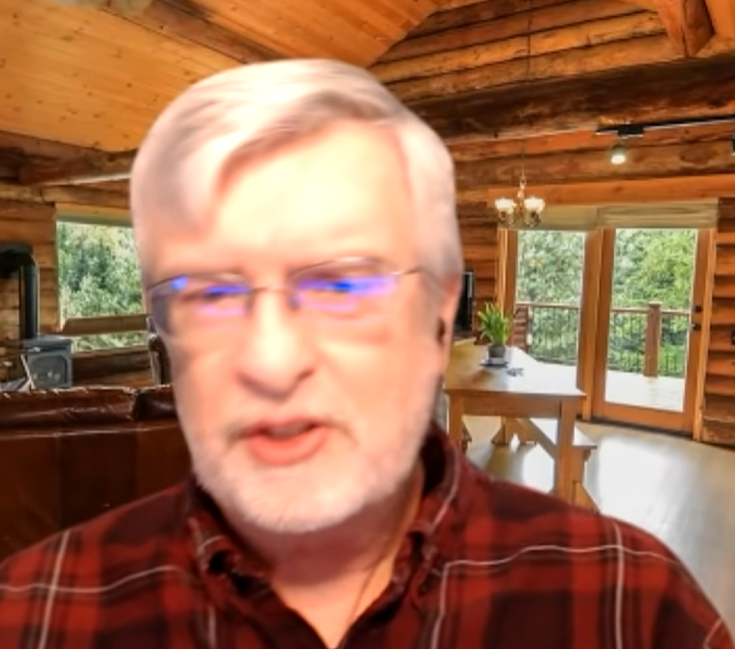
B.W. Melwin — Author of Hell's Deepest Dominion (recommended reading)
During the experience, Melwin reports floating upward from his body toward the ceiling of his room. From that vantage point, he observed specific physical details of the ceiling — marks and features he would not have noticed or remembered from normal floor-level perspective. When he was resuscitated and recovered, he went to examine the ceiling. The marks he had seen while floating — the exact marks — were there. This is the same category of verification as Pam Reynolds' case: a perception reported from an impossible vantage point, independently confirmed by physical evidence.
Hell, in his account, was not a generic pit of fire. It was specific to each soul — crafted in a way that seemed designed for individual persons, as though shaped by intimate knowledge of them. He describes it not as a place of theatrical punishment but as a place of perfect, terrible relevance. This detail — that Hell is not one-size-fits-all but particular — aligns with the theological tradition that judgment is personal and precise.
Recommended: B.W. Melwin — Hell's Deepest Dominion
A first-person account of clinical death, encounter with Christ, and a vision of Hell — including physical evidence verified upon return. If you want to understand what the afterlife testimonies of those who saw the other side actually say, this is an essential read. The physical verification component — the ceiling marks Melwin saw while floating and then confirmed — puts this in a different evidential category from pure subjective report.
Taken alongside the van Lommel study in The Lancet, the Pam Reynolds case, and the AWARE study, Melwin's account is not an outlier. It is part of a consistent pattern: consciousness persisting and perceiving accurately when the brain is clinically inactive, and returning with verifiable information it could not have obtained through normal sensory channels.
→
⭐ The Star Formation Problem Angular momentum catastrophe · ALMA data · Factor 100×
Stars Shouldn't Exist. The Math Says So.
Something the astronomy textbooks don't emphasize: according to standard gravitational collapse models, stars should not be able to form. The problem is called the angular momentum catastrophe.
When a gas cloud begins to collapse under gravity, it rotates. As it contracts, angular momentum is conserved — like a spinning figure skater pulling in their arms. Rotation speeds up dramatically. At a certain point, centrifugal force exceeds gravitational force and the collapse stops. The math predicts that most collapsing gas clouds should never produce stars. (Spitzer, Diffuse Matter in Space, Interscience Publishers, 1968).
🔭 ALMA Telescope: Observed vs. Predicted Star Formation Rates
Standard model predicted star formation efficiency: ~30–50% of available molecular cloud mass
Observed efficiency (ALMA survey data): ~1–3%
Discrepancy factor: ~100×
Source: Heiderman et al., The Astrophysical Journal, 723:1019–1033, 2010. Confirmed by Offner & Chaban, Astrophysical Journal, 847:104, 2017; Krumholz, McKee & Bland-Hawthorn, Annual Review of Astronomy and Astrophysics, 57:227–303, 2019.
Standard model predicted star formation efficiency: ~30–50% of available molecular cloud mass
Observed efficiency (ALMA survey data): ~1–3%
Discrepancy factor: ~100×
Source: Heiderman et al., The Astrophysical Journal, 723:1019–1033, 2010. Confirmed by Offner & Chaban, Astrophysical Journal, 847:104, 2017; Krumholz, McKee & Bland-Hawthorn, Annual Review of Astronomy and Astrophysics, 57:227–303, 2019.
Magnetic Braking: The Proposed Fix That Creates New Problems
Astrophysicists proposed magnetic braking — magnetic field lines threading through a collapsing cloud would transfer angular momentum outward. In practice, observations consistently find that magnetic braking is either too strong (preventing collapse entirely), too weak (not solving the angular momentum problem), or disconnected from the ionized regions where it must operate. (Li et al., The Astrophysical Journal, 738:180, 2011).
"Star formation is slow and inefficient... the fraction of gas that ends up in stars is much smaller than naive estimates would suggest, and we lack a complete theoretical understanding of why."
The universe's star-forming machinery is regulated at a rate that happens to produce a habitable cosmos. Something maintains that regulation. "We don't understand it" is not an argument against design. It is an admission that the natural explanation is missing.
→
🎥 Watch — The Evidence Presented Recommended viewing
This video covers much of what is documented in this archive — recommended for those who prefer hearing the arguments laid out systematically in full. Share it with someone who would never read a long page like this one.
→
📊 The Supernatural Hypothesis — What the Materialist Must Believe Converging evidence · The final accounting
Let's Actually Think About What We Just Went Through
Stop and actually think about what is on this page.
We have a piece of linen with a man's image on it. No paint. No dye. No pigment of any kind. When you run it through a VP-8 analyzer it spits out 3D data. That cannot happen with a painting. Medieval artists didn't have that technology. We don't fully understand how it got there today. The image exists in a layer 200 nanometers thin with no known mechanism to produce it.
We have over 700 specific Biblical locations confirmed by archaeology. Zero disproven. Silver amulets from 925 BC with the exact text in the Bible today. A 9th-century inscription naming the House of David — discovered by accident. Hezekiah's tunnel still walkable. A Pontius Pilate stone proving the man was real.
We have prophecies written with specific names, specific cities, specific amounts of silver, centuries before fulfillment. Eight of them: 1 in 1017. Forty-eight: 1 in 10157. The impossibility threshold is 1 in 1050. We are 10107 orders of magnitude past that line.
We have the Cambrian Explosion — virtually every animal body plan appearing simultaneously with no fossil precursors, in a window so brief Darwin himself called it a potential fatal objection to his own theory. 165 years of searching have not produced the required precursors.
We have DNA — 3.2 billion base pairs of specified, functional, information-bearing code. Richard Dawkins himself called it "uncannily computer-like." Shannon's information theory has one known source of specified complex information. Intelligence. Not one exception in the history of the field.
We have James Tour — one of the ten most-cited chemists alive — saying nobody knows how life started from non-life without a chemist guiding the process. Douglas Axe measuring 1 in 1077 for a single functional protein fold. A minimum viable cell requires 250–500 simultaneously. The combined odds: 1 in 1038,500. Against an impossibility threshold of 1 in 1050.
We have the cosmological constant tuned to 1 in 10120 precision. Roger Penrose calculating the initial conditions of our universe at 1 in 10^(10^123). Fred Hoyle — a lifelong atheist — looking at the carbon-12 resonance level and writing that the universe looks like a put-up job.
We have cardiac arrest patients reporting accurate, verifiable perceptions of their physical environment while EEG-flat and blood-drained — published in The Lancet and Resuscitation. We have Pam Reynolds describing her bone saw and the surgical team's conversation while brain-dead by every clinical measure. We have B.W. Melwin floating to his ceiling during clinical death and returning to find the marks he saw — there.
We have consciousness that cannot be produced by brain stimulation, that survives half-brain removal, that persists as a separate identity in conjoined twins sharing the same tissue — and that quantum mechanics says must be non-physical to collapse the wave function in the first place.
And the Transcendental Argument: the very tools used to argue against all of this — logic, mathematical reasoning, the reliability of scientific method — all presuppose an ordered, rational, morally-governed universe. Theism predicts that universe. Materialism merely assumes it without explanation.
So here is the question.
According to the materialist story: the Shroud is a forgery nobody can explain. The prophecies are coincidences the math says are impossible. The Cambrian Explosion will be explained eventually. The DNA code wrote itself. The protein problem will be solved. The fine-tuning is luck across infinite universes we cannot test. Consciousness is "emergent." The NDEs are hallucinations from a brain showing zero activity. And the laws of logic just happen to govern the universe for no particular reason.
Is that really more parsimonious than the alternative?
"Either this is the greatest string of coincidences in the history of the cosmos, or someone was sending a message. There is no third option."
🧠 The naturalist has to accept more miracles than the theist.
The theist says: "An intelligent mind designed reality."
The naturalist says: "Nothing exploded, turned into laws tuned to 1 in 10^(10^123) precision, wrote its own genetic code, built self-replicating cells from chemistry that demonstrably cannot do it unguided, produced consciousness from non-conscious matter in defiance of quantum mechanics, and then generated minds capable of discovering all of this — and none of it pointed at anything."
The second worldview requires more faith. Significantly more.
The theist says: "An intelligent mind designed reality."
The naturalist says: "Nothing exploded, turned into laws tuned to 1 in 10^(10^123) precision, wrote its own genetic code, built self-replicating cells from chemistry that demonstrably cannot do it unguided, produced consciousness from non-conscious matter in defiance of quantum mechanics, and then generated minds capable of discovering all of this — and none of it pointed at anything."
The second worldview requires more faith. Significantly more.
The question isn't whether you have faith. Every worldview requires it. The question is where you're putting it. The archive stands. The data is on the table.
The question isn't can you believe? The question is can you afford not to, given what the evidence actually says?
→
📚 Cited Sources & Further Reading
Peer-reviewed papers, academic books, and institutional sources referenced in this archive. Verify everything. Skepticism is encouraged.
- Shroud image analysis: Jackson, J.P. & Jumper, E.J. (1977). "Three-Dimensional Characteristic of the Shroud Image." IEEE 1977 International Conference on Cybernetics and Society, pp. 559–575.
- Shroud blood chemistry: Heller, J.H. & Adler, A.D. (1981). "A Chemical Investigation of the Shroud of Turin." Canadian Society of Forensic Science Journal, 14(3), 81–103.
- Shroud carbon dating rebuttal: Rogers, R.N. (2005). "Studies on the radiocarbon sample from the Shroud of Turin." Thermochimica Acta, 425(1–2), 189–194.
- Shroud image superficiality: Fanti, G. & Maggiolo, R. (2004). "The double superficiality of the frontal image of the Turin Shroud." Journal of Optics A, 6(6), 491–503.
- Cosmological fine-tuning: Barrow, J.D. & Tipler, F.J. (1986). The Anthropic Cosmological Principle. Oxford University Press.
- Cosmological constant problem: Weinberg, S. (1989). "The cosmological constant problem." Reviews of Modern Physics, 61(1), 1–23.
- Penrose fine-tuning calculation: Penrose, R. (2004). The Road to Reality. Knopf, Chapter 27.
- Hoyle carbon resonance: Dunbar, D.N.F. et al. (1953). "The 7.68-MeV state in C12." Physical Review, 92(3), 649–650. Commentary: Hoyle, F. (1982). Annual Review of Astronomy and Astrophysics, 20, 1–35.
- Kalam / BGV theorem: Borde, A., Guth, A.H. & Vilenkin, A. (2003). "Inflationary spacetimes are incomplete in past directions." Physical Review Letters, 90(15), 151301.
- Ontological argument: Plantinga, A. (1974). The Nature of Necessity. Oxford University Press.
- Cambrian explosion: Erwin, D.H. et al. (2011). "The Cambrian Conundrum: Early Divergence and Later Ecological Success in the Early History of Animals." Science, 331(6021), 721–725. Meyer, S.C. (2013). Darwin's Doubt. HarperOne.
- DNA as information: Crick, F.H.C. (1958). "On Protein Synthesis." Symposia of the Society for Experimental Biology, 12, 138–163. Meyer, S.C. (2009). Signature in the Cell. HarperOne. Shannon, C.E. (1948). "A Mathematical Theory of Communication." Bell System Technical Journal, 27, 379–423.
- Protein fold probability: Axe, D.D. (2004). "Estimating the prevalence of protein sequences adopting functional enzyme folds." Journal of Molecular Biology, 341(5), 1295–1315.
- Origin of life critique: Tour, J.M. (2016). "Animadversions of a Synthetic Chemist." Inference: International Review of Science, 2(2). Bernhardt, H.S. (2012). "The RNA world hypothesis." Biology Direct, 7:23. Sutherland, J.D. (2016). Nature Chemistry, 8, 1027–1029.
- Homochirality: Meierhenrich, U. (2008). Amino Acids and the Asymmetry of Life. Springer.
- Prophecy probability: Stoner, P.W. (1963). Science Speaks. Moody Press.
- Archaeology — Ketef Hinnom: Barkay, G. et al. (2004). Bulletin of the American Schools of Oriental Research, 334, 41–71. IAA accession 1979-1283/1284.
- Archaeology — Tel Dan Stele: Biran, A. & Naveh, J. (1993). Israel Exploration Journal, 43(2–3), 81–98. IAA 1993-3162.
- Archaeology — Siloam Inscription: Millard, A.R. (1994). Tyndale Bulletin, 45(1), 113–117.
- Archaeology — Pilate Stone: Frova, A. (1961). Rendiconti dell'Istituto Lombardo, 95, 419–434.
- Lourdes medical bureau: Theillier, P. (2013). Des guérisons inexpliquées à Lourdes. Éditions de l'Emmanuel. lourdes-france.org →
- Lourdes — Alexis Carrel: Carrel, A. (1950). The Voyage to Lourdes. Harper & Row.
- NDE — Dutch prospective study: van Lommel, P. et al. (2001). "Near-death experience in survivors of cardiac arrest." The Lancet, 358, 2039–2045.
- NDE — AWARE study: Parnia, S. et al. (2014). "AWARE — AWAreness during REsuscitation." Resuscitation, 85, 1799–1805.
- NDE — Pam Reynolds case: Sabom, M. (1998). Light and Death. Zondervan, pp. 37–52.
- Quantum consciousness: Wigner, E.P. (1967). Symmetries and Reflections. Indiana University Press. Stapp, H.P. (2011). Mind, Matter and Quantum Mechanics, 3rd ed. Springer.
- Resurrection minimal facts: Habermas, G.R. (1996). The Historical Jesus: Ancient Evidence for the Life of Christ. College Press. Habermas, G.R. & Licona, M.R. (2004). The Case for the Resurrection of Jesus. Kregel. Wright, N.T. (2003). The Resurrection of the Son of God. Fortress Press.
- Transcendental argument: Bahnsen, G.L. (1996). Always Ready. Covenant Media Foundation. Van Til, C. (1932). A Survey of Christian Epistemology. Presbyterian and Reformed Publishing.
- Star formation: Heiderman, A. et al. (2010). The Astrophysical Journal, 723, 1019–1033. Krumholz, M.R. (2014). Physics Reports, 539, 49–134. Offner, S.S.R. & Chaban, J. (2017). Astrophysical Journal, 847, 104. Li, Z.-Y. et al. (2011). The Astrophysical Journal, 738, 180.
- Israel Museum artifact catalog: imj.org.il →
- Book recommendation: Melwin, B.W. Hell's Deepest Dominion — first-person account of clinical death, vision of Hell, and physical verification upon return.